

Time is brain:
Early MS diagnosis is crucial
Anyone experiencing symptoms consistent with MS should seek early diagnosis and discuss effective treatment options with their healthcare team
Originally published: May 30, 2025
This article was originally shared on Healthing.ca

Karen and her husband after a pilates session. She is moving in ways she never thought she would again. SUPPLIED
Canada has one of the highest rates of multiple sclerosis (MS) in the world. The neurological disease affects over 90,000 people in Canada, with nearly 4,400 new diagnoses every year. Common symptoms include fatigue, numbness, vision problems, weakness and balance issues. Thankfully, we know more about the disease today than ever before.
One of the most important findings about MS revolves around the concept of "time is brain." Often used in the context of strokes, time is brain boils down to the importance of treating patients as quickly as possible.
"The war is often won or lost in the first few years," says Dr. Paul Giacomini, a neurologist and the MS clinic director at Montreal Neurological Institute and McGill University Health Centre. "The reality is you really need to intervene early. This is the key argument in time is brain."
Advocate for early and effective MS treatment: Karen's story
Ten years ago, the idea of quickly treating MS wasn't common. And even today, the concept is not as widespread as it could be. Anyone experiencing symptoms consistent with MS should seek early diagnosis and discuss effective treatment options with their healthcare team.
Karen Jacoby has lived through many MS extremes. Her relapsing-remitting MS — which includes periods of flare ups and perceived recovery — went undetected for years due to misdiagnoses, giving the disease a dangerous head start.
"A second lost in advocacy could mean a lifetime lost in function," she says. "If something feels off, push for answers. If you're newly diagnosed, don't wait — ask about treatment options right away and organize a team that includes a neurologist, family doctor, physical therapists, and mental health support."
Karen lived with MS flare ups for years, but she didn't know that's what they were. "Regular visits to my doctor and blood tests left me with no answers," she says. "We justified my fatigue, numbness and poor mobility as related to my occupation."
Karen says she thought her job managing a luxury retail store was taking a toll on her health. She was on her feet for long hours, often wearing high heels, on unforgiving cement floors.
In 2018, she experienced full leg paralysis. A frantic visit to the emergency room still failed to detect her MS. The paralysis went away, giving her false hope. "After recovering from my leg paralysis, I chose to make a career change expecting that it would make a difference," she says.
For a while, things did seem to improve for Karen. But behind the scenes, her brain's ability to compensate for MS-related damage was rapidly depleting.
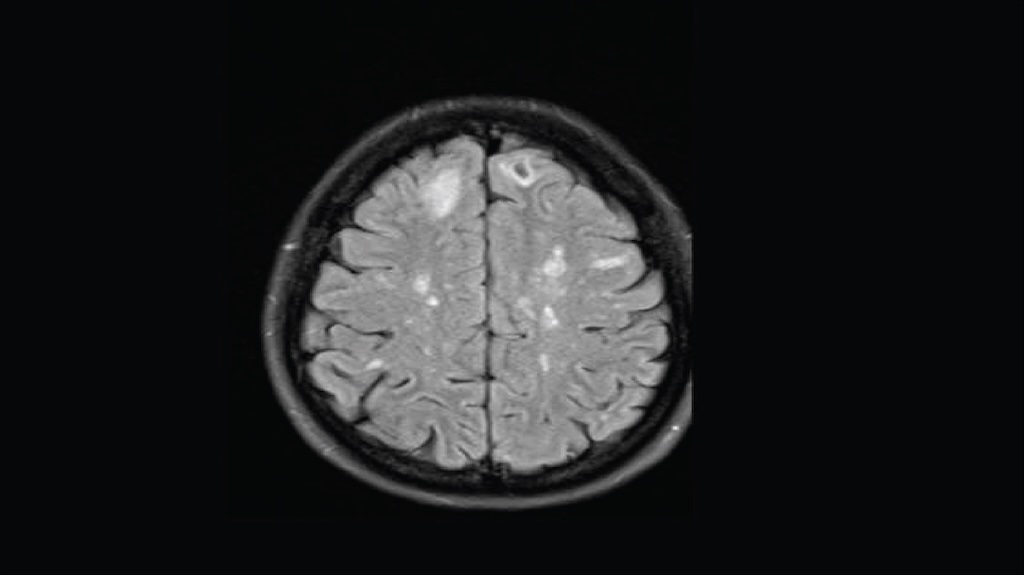
After months of unexplained symptoms, Karen’s baseline brain MRI was one of the first steps to confirming her MS diagnosis. SUPPLIED
What you lose you don't get back
"Early MS has a cruel paradox," says Dr. Giacomini. "Patients often feel well at the beginning and, even if they have bad relapses like Karen did, they may seem to fully recover. Their brain has mechanisms that can compensate to minimize the impact, and the patient's interpretation can be: 'Oh, it's not so bad. I recovered.' But we know that those compensatory mechanisms are finite. Once they're gone, they're gone."
Karen's first major relapses and recoveries happened well before she was officially diagnosed in 2020. Increasingly serious symptoms drove her to insist on a brain MRI. Thankfully, once her MS was detected, her neurologist convinced her to start treatment as soon as possible.
"My doctor said, 'you need to make a decision really quickly,'" remembers Karen. She did just that, taking her doctor's recommendation for an immediate and suitable treatment.
Living life to the fullest with MS
"Patients are their own best advocates," says Dr. Giacomini. "They should tell their neurologist that they want to reduce the frequency of relapses and slow down the progression as a treatment goal."
There are many MS treatments available today, and each one comes with different risks and may not be suitable for everyone. Finding the most effective treatment for you — as early as possible — is one of the keys to successfully managing the disease. Using a tool like LiveYourLifeMS.ca can help people living with MS prioritize what matters most to them in their treatment approach.
"MS is a long game," says Karen. "Starting and staying on treatment is an investment. The goal isn't just to feel okay today — but to slow down the progression of the disease. In the years to come I will look back and thank myself. It's the best decision I ever made."